STREAMD | The Hidden Cost of a Phone Call
It doesn't feel like a crisis. It feels like a Tuesday.
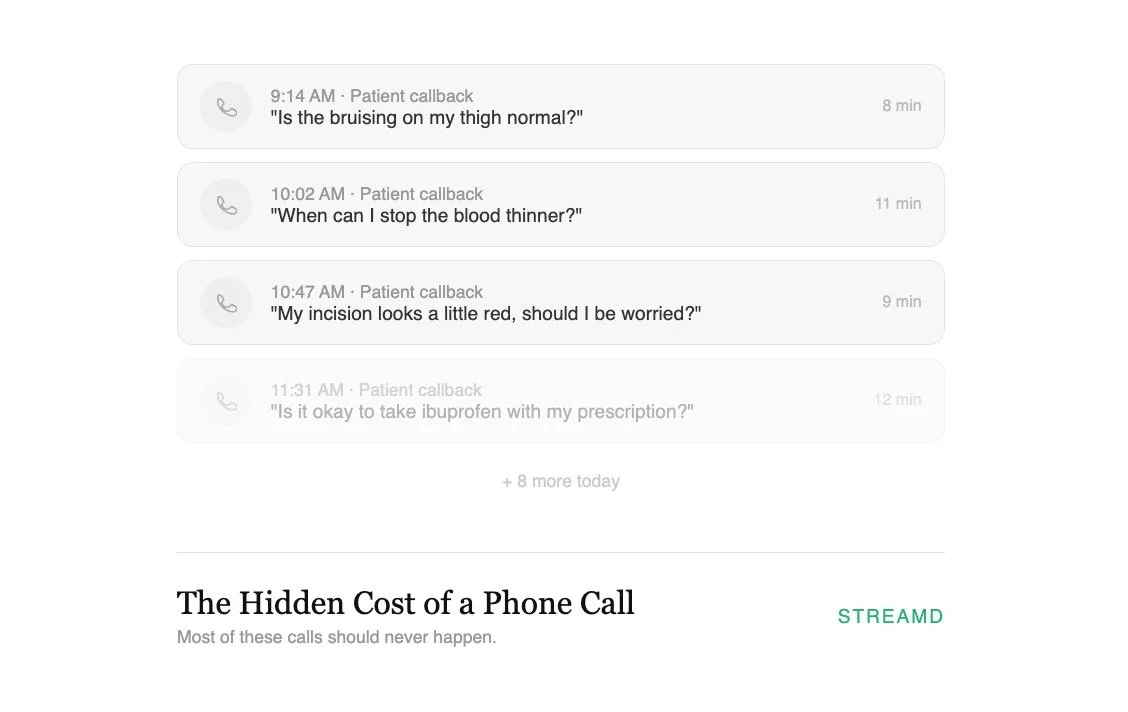
A patient calls to ask whether the bruising on their thigh is normal. A medical assistant picks up, puts them on hold, pulls the chart, tracks down the answer, calls back, leaves a voicemail, waits. The patient calls again. Someone else picks up. The cycle repeats.
By the end of the day, twelve calls came in. Three of them needed clinical attention. Nine of them needed reassurance.
No one logged it as a problem. It just felt like work.
What a phone call actually costs
Healthcare has spent considerable energy measuring the cost of readmissions, emergency department visits, and surgical complications. It has spent almost none measuring the cost of the phone call that precedes them, or the nine that don't.
The math is straightforward. A medical assistant handling post-surgical patient calls spends an average of eight to twelve minutes per interaction when you account for hold time, chart review, callback attempts, and documentation. At a fully-loaded cost of $25 to $35 per hour for clinical support staff, each call costs a practice between $3 and $7 to resolve.
That sounds trivial until you multiply it. A surgeon performing 400 cases per year, each patient generating an average of 2.6 calls in the first six weeks of recovery, produces more than 1,000 inbound contacts per year from post-surgical patients alone. At the conservative end, that is $3,000 in staff time annually, per surgeon, for calls that are largely repetitive and largely preventable.
For a practice with five surgeons, that number approaches $15,000 per year before anyone has looked at the downstream costs: delayed responses that escalate to urgent visits, staff overtime during high-volume recovery periods, and the subtler cost of a front desk that is too busy answering routine questions to identify the call that actually matters.
The call that actually matters
Hidden inside every phone queue is a signal problem.
When a patient with a genuine complication calls and reaches a line tied up with routine anxiety calls, the response is slower. The triage is noisier. The chance that something important gets missed is higher.
Published research on surgical patient communication has found that the volume of routine calls directly competes with the detection of early complications. Practices that reduce preventable call volume don't just save staff time. They improve the signal-to-noise ratio for the calls that require clinical judgment.
This is the case that rarely gets made in practice administrator meetings, because it requires thinking about what isn't happening rather than what is. The complication that was caught early because the line was clear. The nurse who had bandwidth to notice something was off. These outcomes don't appear in a cost report. They appear, eventually, in readmission rates and malpractice exposure.
Why the calls keep coming
The root cause is not patient anxiety. It is an information gap delivered at the wrong time.
Surgical patients are educated at their pre-operative appointment, under stress, while processing logistics, often accompanied by a family member who is also anxious. Studies consistently show that patients retain less than half of what they are told in a clinical encounter. The questions they ask on day three of recovery are not questions they forgot to ask before surgery. They are questions they did not yet know they had.
Proactive, time-released communication, delivered at the moment the question becomes relevant rather than three weeks before it arises, closes this gap before it becomes a phone call. Patients who receive the right information at the right time call less, recover with more confidence, and report higher satisfaction regardless of their clinical outcome.
The intervention is not complicated. The barrier has been finding a way to deliver it that doesn't create new work for an already stretched clinical team.
Invisible infrastructure
The practices that have solved this problem have done so by treating patient communication the way they treat scheduling or billing: as infrastructure, not as a task. Something that runs in the background, handles volume autonomously, and surfaces the exceptions that need human attention.
When that infrastructure works well, a surgeon performing 400 cases a year sees a 77% reduction in post-surgical calls. Staff hours previously spent on hold cycles are redirected toward patients who need them. The phone queue becomes a triage tool rather than a triage problem.
The cost of the phone call was never really the phone call. It was everything the phone call was standing in the way of.
STREAMD is an AI-powered patient engagement platform built by orthopaedic surgeons for surgical practices. Learn more at www.mystreamd.com.